
A stopped packaging line is not ready to restart because a reset button clears the alarm. You need to secure the machine, identify whether the fault lies in the motor or another drive-train component, test the electrical system without damaging connected electronics, and prove safe operation under load before releasing production.
Key takeaways
- Apply lockout/tagout and verify zero voltage before touching the motor.
- Check the machine, motor wiring and drive before replacing components.
- Remove mechanical obstructions and stored energy before a controlled restart.
- Record fault codes, readings and loaded-run behaviour for future recovery.
Secure the stopped machine before touching the motor
The first action after an unplanned shutdown is to stop movement and secure the packaging machine before touching its motor. Press the emergency stop, open the main disconnect, apply lockout/tagout, release pneumatic pressure, spring force, elevated loads and other stored energy, then verify zero voltage with a properly rated meter at the motor terminals.
1. Check that guards, access-door switches, emergency stops, brake circuits and stored-energy controls are intact. Resetting the emergency stop must permit a restart command, not restart the motor automatically.
2. Record the outage conditions before testing: stalled product, jammed conveyor, abnormal temperature, washdown water, monsoon humidity, dust or oil vapour. These facts determine whether drying, cleaning or mechanical service comes first.
3. Inspect the terminal-box glands, cable insulation, drain holes, fan cover and cooling passages. Blocked drains retain condensation, while dust on a totally enclosed fan-cooled motor restricts cooling.
4. Isolate the motor from the VFD or electronic drive before using a megohmmeter. Test the motor and cable separately under the equipment maker’s procedure; applying the test through a connected drive can damage its electronics.
5. Restore guards and interlocks, remove tools and confirm that nobody remains in the danger zone before releasing the lockout. This packaging motor shutdown recovery step prevents a hurried reset from causing a second incident.
Separate a motor fault from a machine or drive fault
A failed start does not prove that the motor failed. Compare the fault code, control command, measured voltage, and mechanical load before resetting anything; the failed part is the one that fails the isolated check.
- No start: confirm the controller issued a run command, the VFD shows “ready,” the safety circuit is reset, and the overload relay or contactor has not opened.
- Instant trip: check phase balance, drive output, motor-cable continuity, and the drive’s overcurrent history. A short acceleration ramp can mimic a winding fault.
- Runs uncoupled but trips when coupled: inspect the gearbox, coupling alignment, brake release, machine jam, and conveyor torque.
- Hums, rotates slowly, or loses torque: check for a missing phase, seized bearing, incorrect VFD motor data, or low supply voltage.
- Runs at the wrong speed or direction: compare encoder feedback, commanded frequency, phase sequence, and stored drive parameters.
For packaging machine motor recovery in pune, record the outage condition before choosing a test. Use a checklist for monsoon humidity, washdown water, dust, oil vapour, abnormal temperature, and a stalled load; each points to a different inspection.
Isolate the motor and cable from the VFD before applying a megohmmeter, because the test can damage drive electronics. Record the motor asset ID, insulation resistance and test temperature, VFD parameter backup, protection settings, no-load and loaded current, vibration, and the final safety-function test.
A motor that passes no-load testing but fails under load directs attention to the machine, not repeated resets.
Inspect the motor, wiring, drive and insulation safely
Do not energise until the outage conditions and the motor’s physical condition are recorded. Note exposure to monsoon humidity, washdown water, dust, oil vapour, abnormal heat, or a stalled load; each condition changes whether drying, insulation testing, or gearbox service comes first.
Complete these checks with the machine isolated, locked out, stored energy released, and zero voltage verified:
- Restore emergency-stop, guard-interlock, access-door, brake, and stored-energy controls. Resetting an emergency stop must allow a restart command, not start the motor automatically.
- Inspect terminal-box glands, cable insulation, earth connection, terminals, drain holes, fan cover, and cooling passages. Blocked drains retain condensation; dust on a fan-cooled motor causes overheating after a normal start.
- Turn the shaft by hand where safe. Investigate rubbing, seized bearings, coupling misalignment, gearbox resistance, or a brake that fails to release.
- Disconnect the motor and cable from the VFD before using a megohmmeter. Test them separately under the equipment manufacturer’s procedure; a connected drive can suffer electronics damage.
- Check phase-to-phase resistance, insulation resistance, earth continuity, terminal tightness, VFD parameter backup, and overload or protection settings.
| Inspection result | Decision before energising | Risk if ignored |
|---|---|---|
| Dry, clean motor; sound cable | Proceed to controlled no-load test | A hidden wiring fault can trip the drive |
| Moisture, oil, damaged insulation | Dry, repair, and retest | Leakage, short circuit, or shock |
| Free shaft but load-side resistance | Inspect coupling, brake, or gearbox | A motor fault is wrongly diagnosed |
| Good insulation but blocked cooling | Clean passages first | Overheating during production |
Record insulation values and test temperature as part of packaging machine motor care.
Clear the mechanical cause and perform a controlled restart
Do not treat an emergency-stop reset as proof that the machine is ready. Confirm that the guard interlocks, access-door switches, brake release circuit, and stored-energy controls operate correctly; resetting the emergency stop must allow a restart command, not start the motor by itself. Never bypass a safety device to clear a jam faster.
With power isolated, remove the obstruction and inspect the load path. Turn the motor and driven shaft by hand where safe, checking for rubbing, seized bearings, a locked gearbox, or abnormal resistance.
Verify coupling alignment, coupling condition, gearbox lubrication, brake release, conveyor tension, and the VFD’s motor data, direction, current limit, acceleration ramp, and control mode.
Restore the coupling only after the shaft turns freely. Run the motor uncoupled or at no load briefly, then stop and inspect for noise, vibration, heating, and unstable speed.
A motor that runs freely but trips when coupled points to excessive load torque, a jammed gearbox, brake drag, misalignment, or an acceleration ramp that is too aggressive—not automatically to a winding fault.
- If the VFD was stored through a long outage, follow its manufacturer’s DC-link capacitor reforming or staged-voltage procedure before full energisation.
- Start in jog or low-speed mode with personnel clear, then increase speed gradually.
- Test stop, emergency stop, guard opening, brake action, and restart inhibition before releasing production commands.
If the shaft binds again, the motor trips, or the coupling heats, isolate it and correct the mechanical cause before another attempt.
Monitor the first loaded run and document the recovery
Do not release the machine to production because it has run for five minutes. Base the decision on the outage conditions and the first loaded cycle. Record exposure to monsoon humidity, washdown water, dust, oil vapour, abnormal temperature, or a stalled load; each condition points to a different follow-up inspection.
Record these recovery results:
- Motor serial number or asset ID, insulation-resistance values, and test temperature
- Bearing or gearbox work completed, oil condition, leaks, breather condition, and shaft-seal status
- VFD parameter backup, protection settings, and confirmed rotation direction
- No-load current, loaded current on each phase, running speed, and winding or frame temperature
- Vibration value, measurement point, mounting condition, speed, and load
- Gearbox noise, coupling behaviour, brake release, and the final emergency-stop, guard-interlock, and access-door tests
Compare the readings with the machine’s previous baseline. ISO 20816 requires vibration measurements to be interpreted with operating and measurement conditions; a single vibration number cannot diagnose a fault.
Call a specialist before repeated restarts if insulation resistance is low, current is unbalanced, temperature rises rapidly, vibration increases under load, oil looks milky, or the fault returns after a reset.
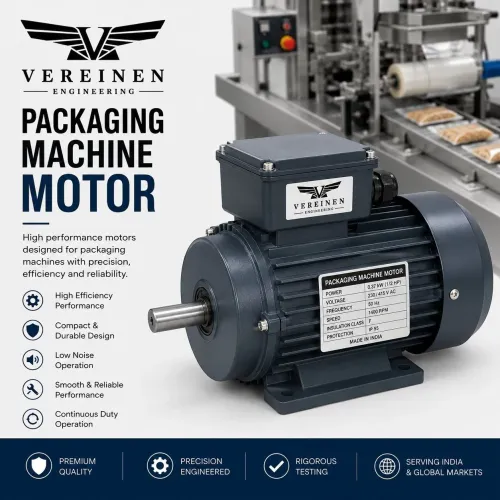
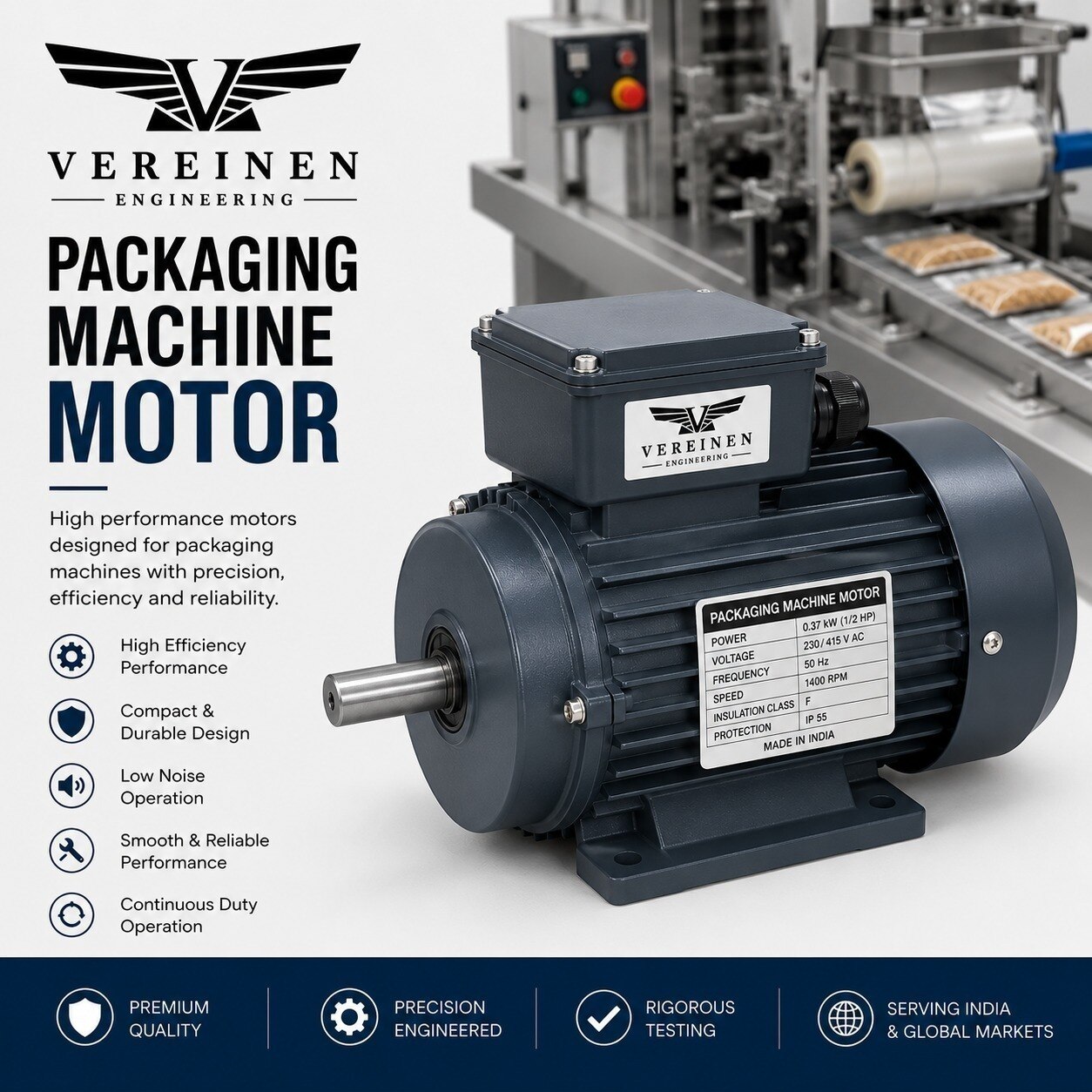
A packaging machine motor manufacturer for recovery steps in Pune, such as VEREINEN ENGINEERING, is useful when you need motor, gearbox, and drive findings checked together rather than replacing the motor by guesswork. Restore every safety function before enabling production commands.
Related product
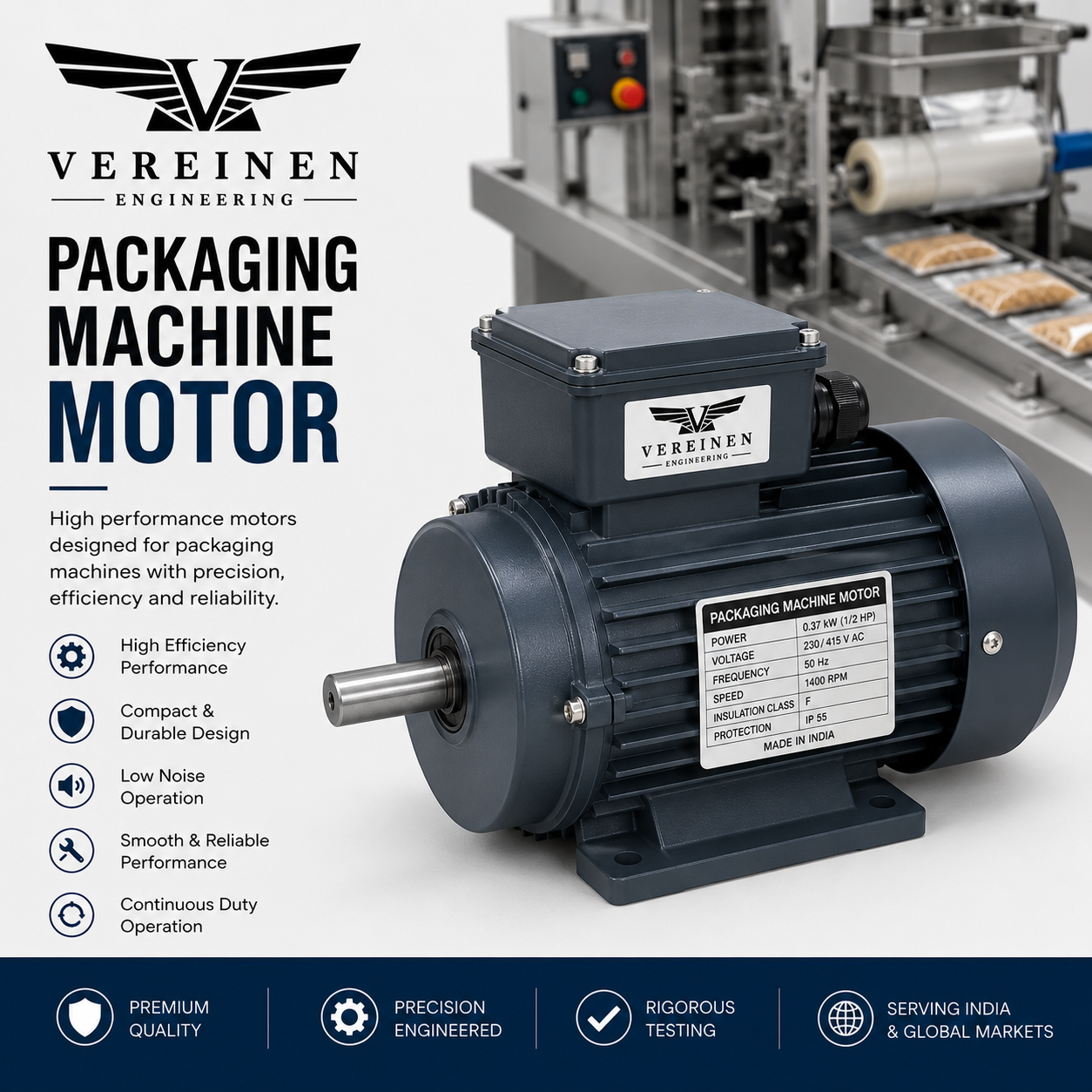 | Packaging Machine Motor Vereinen Engineering is a Pune-based OEM manufacturer of premium-quality Packaging Machine Motors, designed to deliver precise motion control, high... View product → |
Frequently asked questions
What should you do before touching a stopped packaging machine motor?
Press the emergency stop, open the main disconnect, apply lockout/tagout, release pneumatic pressure and other stored energy, then verify zero voltage at the motor terminals with a properly rated meter.
How do you separate a motor fault from a machine or drive fault?
Review the drive fault code, inspect motor connections and shaft movement, and test the machine for mechanical binding before condemning the motor.
What should you inspect on the motor, wiring, drive and insulation?
Check terminals for loose or burned connections, cables for damage, the drive for alarms and ventilation problems, and insulation with an appropriate insulation-resistance test after isolating sensitive electronics.
How should you restart a packaging machine after clearing the fault?
Remove the mechanical cause, restore guards and connections, release lockout under the site procedure, jog the machine without load, then run it at low speed before applying production load.
What should you document after the first loaded run?
Record the fault code, voltage and current readings, insulation results, corrective action, unloaded test, loaded behaviour and any abnormal heat, noise or vibration.