
A ventilation shutdown does not prove that the induction motor has failed, but restarting before the trip cause and airflow path are understood can create a second overload, thermal trip, or unsafe fan movement. You will be able to isolate the equipment, identify the shutdown type, inspect the motor and ventilation path, perform a controlled restart, and decide when the motor must remain out of service.
Key takeaways
- Isolate and lock out the motor before inspecting or resetting it.
- Check supply, overload trips, bearings, airflow blockage, and process interlocks.
- Restart under controlled conditions while monitoring current, vibration, noise, and temperature.
- Record the fault and match motor duty to the ventilation system’s operating load.
Identify Why the Ventilation Motor Stopped Before Resetting Anything
A stopped ventilation fan does not prove the induction motor has failed. First decide whether the fault is the motor, electrical supply, ventilation path, or process interlock, then open the isolator and secure it against unexpected starting.
- Inspect the overload relay and thermal protection. A trip points to excessive current, a jam, overload, or retained thermal memory; allow the prescribed cool-down period before resetting. Check reset mode, trip class, and full-load-current setting against the nameplate and protection documentation.
- Check for phase loss and undervoltage at the supply, then inspect the emergency-stop circuit, undervoltage release, contactor, soft starter, and variable-frequency drive status. A drive fault for overcurrent, overload, stall, undervoltage, or overtemperature needs diagnosis before reset.
- Check the ventilation path. Blocked filters, dampers, ducts, or impellers can stop a healthy motor’s driven airflow, while a blocked fan cover or failed auxiliary fan can remove the motor’s own cooling airflow.
- For a separately ventilated motor, confirm the auxiliary fan runs before permitting the main motor to start. For a TEFC motor, check that the shaft-mounted cooling fan and external air passages are clear.
- Check for a process interlock that intentionally removed the start command or permissive.
Clear the cause before any ventilation motor shutdown recovery. A practical induction motor restart in Pune begins only after these checks; never reset a relay that still carries thermal memory.
Complete the Pre-Restart Inspection and Know When to Stop
Before energising, complete a fixed inspection sequence; industrial induction motor care begins with proving that the machine is safe to touch and the ventilation path is usable.
- Verify the isolator is open, locked, tagged, and free from stored energy.
- Turn the shaft or coupling only if the machine design permits manual movement.
- Listen for bearing roughness, scraping, or tight spots.
- Inspect the fan or impeller for debris and check filters, dampers, inlet guides, duct obstructions, and discharge paths.
- Check belts, pulleys, and couplings for damage, looseness, or misalignment.
- Confirm every guard is fitted and secure.
- Examine terminal tightness, cable-gland sealing, and the terminal box.
- Look for water ingress, dust tracking, burnt-insulation smell, smoke, abnormal heat, or exposed conductors.
A blocked centrifugal-fan system can overload the fan at restart. Treat these findings as stop conditions:
| Condition | Decision | Required action |
|---|---|---|
| Seized fan or locked rotor | Do not restart | Competent electrical worker tests and repairs the fault |
| Winding damage or insulation failure | Do not restart | Test before repair and retest after repair |
| Exposed live parts, smoke, or damaged guard | Do not restart | Isolate, secure, and repair |
| Repeated overload trips | Do not reset repeatedly | Find and correct the cause |
For suspected condensation after a humid or monsoon shutdown, compare insulation-resistance results with earlier readings. Do not use a universal megohm limit; voltage, temperature, motor size, and test practice affect interpretation. Confirm the anti-condensation heater is off when the motor runs.
This completes ventilation motor shutdown recovery without turning a moisture problem into a winding failure.
Restart a Three-Phase Motor Under Controlled Conditions
After a power interruption, confirm that the rotor has completely stopped before re-energising a motor that coasted down. If the machine is designed to catch a rotating motor, use a starter or VFD with a suitable flying-start function; do not apply a blind restart.
- Put the centrifugal-fan discharge damper or inlet guide in the manufacturer’s prescribed low-load position. Check the emergency-stop circuit, guards, fire controls, and machine permissives.
- Read any VFD fault display before resetting it. Overcurrent, stall prevention, overload, undervoltage, and drive overtemperature can indicate a jam, blocked filter, phase fault, or acceleration-ramp problem.
- Energise the isolator, then issue one deliberate start command. A contactor connects and disconnects the supply; an overload relay responds to excessive motor current and heating; an undervoltage release drops the control circuit when voltage falls.
- Know the starter’s job. A soft starter limits starting stress by ramping voltage, while a VFD controls frequency, voltage, speed, and acceleration.
Fan shaft power rises approximately with the cube of speed. A high-speed start against a wrongly positioned damper or blocked duct can therefore impose excessive load.
Repeated starts are not normal running. Follow the nameplate, motor datasheet, starter limits, and specified hot-start, cold-start, starts-per-hour, and rest-time limits. Those limits govern an induction motor restart in Pune, including selection of an induction motor manufacturer ventilation motor for restart in Pune.
Separate a Motor Fault from a Ventilation-System Fault After Starting
Prove the restart by comparing measured values with commissioning or previous healthy readings, not by noting that the motor turned. A successful start can still hide excessive current, poor airflow, or a failing bearing.
1. Record the baseline and restart readings: trip time and fault code; line-to-line voltage; current on each phase; current imbalance; running current against the motor nameplate full-load current; start duration; time to stable speed; housing or winding temperature; vibration; damper position; filter condition; belt or coupling condition; and ventilation-system permissive status.
2. Use the pattern to locate the fault.
| Electrical evidence | Ventilation-system evidence |
|---|---|
| Low or uneven line voltage, phase-current imbalance, or abnormal supply sequence | Normal voltage with rising current, slow acceleration, or delayed stable speed |
| Motor protection or drive fault that returns after the cause is cleared | Impeller loading, blocked duct or filter, seized bearings, excessive belt tension, coupling drag, or incorrect damper position |
3. Check rotation if airflow is poor. Isolate the motor, prevent an unexpected start, and correct the connection only under competent electrical control; then verify shaft direction against the fan arrow. Wrong rotation can produce poor airflow without proving induction-motor failure.
4. Escalate when current, temperature, vibration, acceleration, or stable-speed time differs from the motor documentation, protection settings, site standard, or previous healthy record. Abnormal noise, heat, or smell alone is not an acceptance test.
Record the trip time, fault code, repair, and post-restart readings so the next ventilation motor shutdown recovery, including an induction motor restart in Pune, is based on evidence.
Prevent the Next Shutdown with Correct Motor Duty and Maintenance Records
After a successful restart, change the maintenance record and confirm the motor’s actual duty before allowing routine operation. The nameplate duty and cooling method govern the decision more than a general performance claim.
IEC motor ratings use a 40 °C reference ambient unless the nameplate or manufacturer data states otherwise. Pune heat, restricted inlet air, clogged filters, and recirculated hot air reduce thermal margin, so obtain manufacturer derating data instead of inventing a temperature or load limit.
Record these details against the trip and post-restart readings:
- Duty, rated current, ambient conditions, and whether the motor is TEFC or separately ventilated
- Auxiliary-fan operation, air passages, filters, ducts, dampers, belts, couplings, and bearing condition
- Line currents, supply voltage, start duration, vibration or bearing temperature, and ventilation permissive status
- Trip time, fault code, repair, grease type, quantity, interval, and the person who approved restart
For industrial induction motor care, follow the specified grease, quantity, interval, and bearing instructions. Over-greasing raises bearing temperature; under-greasing causes lubricant starvation. Do not open sealed-for-life bearings for routine regreasing.
Automatic restart is a machinery-risk decision. Enable it only when the risk assessment allows unexpected fan movement and emergency-stop, guards, fire-control logic, and upstream permissives remain valid; otherwise require a deliberate reset and start.
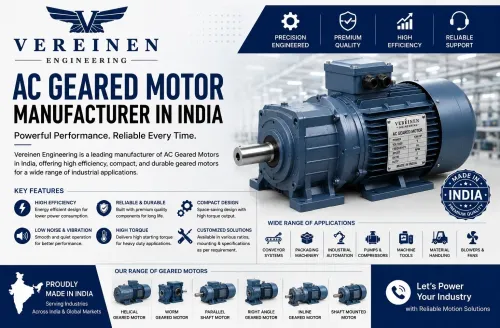
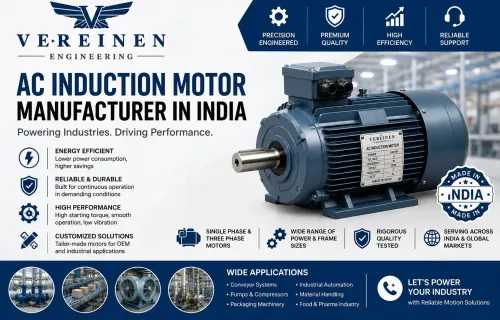
VEREINEN ENGINEERING, an induction motor manufacturer, can help interpret duty, match a ventilation motor for restart in Pune, coordinate a starter or VFD, and document restart limits. The site’s competent electrical and machine-safety personnel retain the final decision.
Related products
 | Induction Motors Vereinen Engineering is a trusted Pune-based OEM manufacturer of high-performance Induction Motors designed to deliver reliable, energy-efficient,... View product → |
 | AC Induction Motor Vereinen Engineering is a Pune-based OEM manufacturer of premium-quality AC Induction Motors, engineered to deliver reliable, energy-efficient, and... View product → |
Frequently asked questions
Why should you identify the cause before resetting a ventilation motor?
A stopped fan can result from a motor fault, phase loss, overload trip, blocked airflow, or a process interlock. Resetting without identifying the cause can damage the motor or create an unsafe restart.
What should you inspect before restarting a three-phase ventilation motor?
Isolate and lock out the supply, then inspect the motor terminals, cables, cooling openings, fan and guard, bearings, airflow path, overload device, and signs of overheating or mechanical damage. Stop and call a qualified technician if insulation, windings, or rotating parts are damaged.
How do you restart a ventilation induction motor under controlled conditions?
Clear personnel and tools, confirm guards are fitted, verify the supply and overload settings, then start the motor while watching rotation, current, vibration, noise, and temperature. Stop it immediately if readings or behaviour are abnormal.
How can you tell whether the motor or ventilation system caused the shutdown?
Compare electrical readings and motor behaviour with airflow, damper position, filters, duct obstruction, pressure, and interlock status. A healthy motor with restricted airflow points to a system fault, while abnormal current, noise, vibration, or heating points to the drive system.