
An oil skimmer on packaging equipment is not matched by motor horsepower alone. You need to identify the collector assembly, calculate its loaded output speed and torque, then check the motor’s enclosure, duty, controls and mounting against the tank and cleaning process. By the end, you will have a specification you can send to suppliers and a checklist for accepting the installed drive.
Key takeaways
- Confirm the tank has a floating oil layer before specifying skimming equipment.
- Size the gearbox for collector speed, fouling and the highest starting load.
- Match enclosure, speed control and electrical protection to the tank environment.
- Compare complete retrofits, then commission the drive under load.
First confirm that an oil skimmer belongs on the packaging line
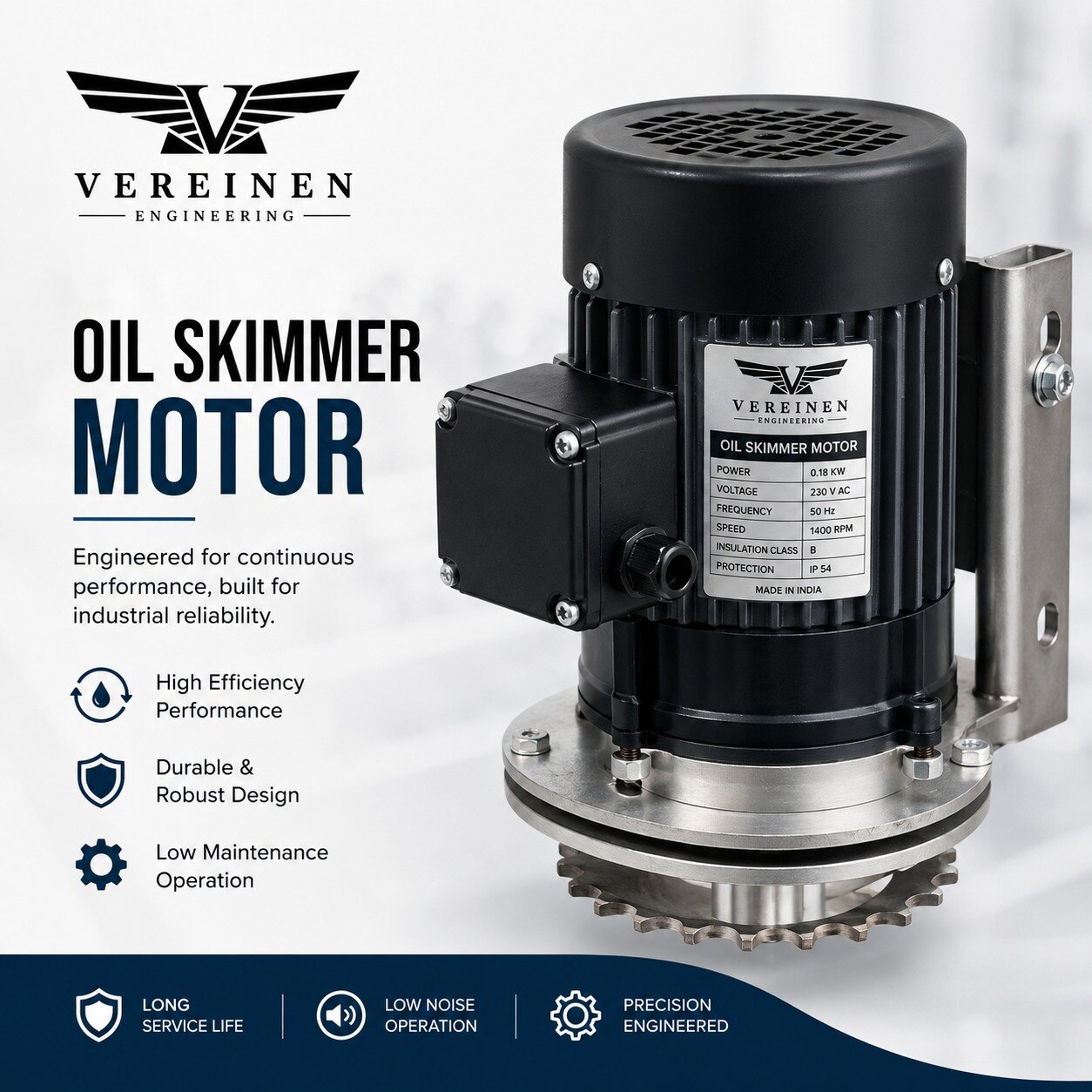
An oil skimmer belongs on a packaging line only when a coolant, wash or parts-cleaning tank has a floating oil layer to remove. Its motor turns a belt, disc, drum or tube through that layer, then carries the oil to a collection tray.
The relevant applications include metal packaging lines, can-washing systems, machining-associated packaging operations and parts-washing stations. A general packaging machine does not automatically need an oil skimmer.
| Complete assembly | Motor alone |
|---|---|
| Collector, shaft, reducer, coupling, tray, guards and mounting bracket | Motor and mounting details only |
| Ready to transfer floating oil from the tank | Requires a compatible collector and support hardware |
| Selected around collector speed and load | Cannot be selected by kW alone |
Reject or reassess the application when:
- The tank has no floating oil layer; use another treatment method.
- Heavy solids reach the collector; add filtration before skimming.
- High-precision positioning is required; choose a positioning drive instead.
- The proposed motor fails the site’s hazardous-area classification; reject it, even with a high IP rating.
Before comparing oil skimmer motor options, obtain the skimmer manufacturer’s recommended speed range, collector diameter, immersion depth and oil-removal rate. Give those figures, along with cold-start viscosity and fouling conditions, to the supplier selecting a motor for skimming equipment.
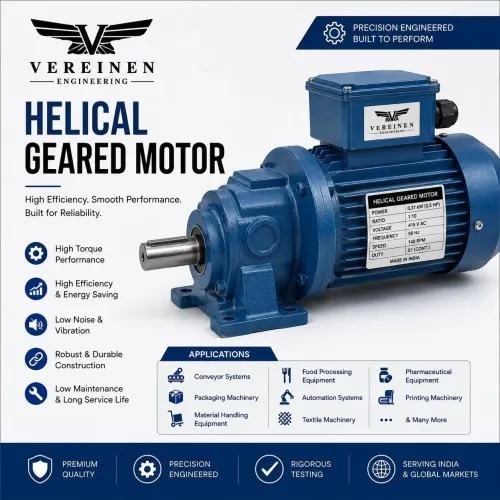
A geared output is usually the practical starting point because belt, disc, drum and tube collectors need controlled low speed rather than a standard motor’s high-speed output.
Size the gearbox from collector speed, fouling and starting load
Choose the gearbox from the collector’s geometry and required output speed, not from a generic ratio. Confirm the belt, disc, drum or tube diameter, immersion depth and manufacturer’s output r/min first.
Estimate running torque with T = 9550 × P/n, where T is N·m, P is kW and n is r/min. Apply gearbox efficiency, then add collector immersion drag, belt or drum drag, shaft and coupling losses, cold-start oil viscosity, sludge buildup, tramp metal and the worst fouling condition.
Verify starting torque, continuous torque and overload margin at the actual oil temperature and contamination state; rated motor power alone can hide a stalled collector.
| Drive option | Strength | Limitation |
|---|---|---|
| AC induction motor with gearbox | Simple, serviceable, strong choice for continuous skimming | Fixed speed unless paired with a controller |
| Geared motor with VFD | Adjustable speed and controlled starting | Requires correct low-speed cooling and commissioning |
| Direct drive | Few transmission parts | Usually unsuitable for low-speed, high-torque collectors |
| PMDC or permanent-magnet drive | Efficient low-speed control and easy reversing | Higher control and maintenance complexity |
| Servo with gearbox | Precise speed, torque and reversing | Highest cost and commissioning effort |
Use S1 duty for continuous skimming. Use S3 or another IEC 60034-1 duty for cyclic operation. Worm gearboxes save space but generate more heat; helical-bevel units run more efficiently but can back-drive. These oil skimmer motor options help match the motor for skimming equipment to the actual fouling load, not the nameplate.
Match speed control, enclosure and electrical protection to the tank
Excessive collector speed can drag coolant, overflow the tray or lose contact with the floating oil layer; insufficient speed reduces oil removal. Obtain the skimmer maker’s recommended speed range before ordering an oil skimmer motor in Pune, and use a controller when temperature or contamination changes the process window.
| Option | Best fit | Main caution |
|---|---|---|
| Fixed-speed geared motor | Stable oil and continuous duty | Poor control when viscosity changes |
| AC motor with VFD | Variable speed, frequent starts or reversing | Check low-speed cooling and braking |
| PMDC or servo drive | Low speed and precise reversal | Higher cost and commissioning effort |
A self-cooled TEFC motor can overheat below base speed because its shaft fan also slows. Specify an inverter-duty motor, separately powered fan, larger frame or verified derating curve. Confirm that the drive tolerates frequent starts, stops and reversing.
Give the supplier a data sheet containing:
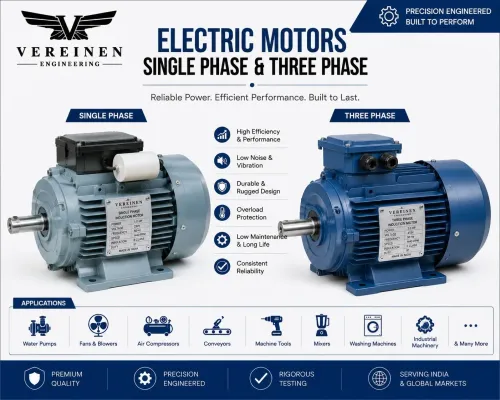
- 230 V single-phase or 400/415 V three-phase, 50 Hz supply, connection, current and VFD compatibility
- Rated motor speed, required output rpm, shaft diameter, mounting pattern and envelope
- Ambient temperature, duty cycle and load profile
- Tank location, splash exposure, shaft seals, cable glands and detergent, salt or oil exposure
Under IEC 60529, IP55 resists operationally harmful dust and water jets; IP66 is dust-tight and resists powerful water jets. Neither rating proves detergent or corrosion resistance.
Choose ordinary enclosed, washdown-capable or explosion-protected equipment from the fluid, vapour, chemicals and hazardous-area classification—not “packaging.” Keep the drive outside the product zone; NSF H1 lubricant permits incidental contact, not leakage into food or medicine.
Compare suppliers by the complete retrofit, not the motor label
A credible oil skimmer motor supplier quotes a retrofit, not a bare nameplate. Require tested output torque and speed, gearbox service factor, duty rating, dimensional drawings, enclosure and insulation details, shaft and mounting tolerances, cable-entry data, lead time, replacement compatibility, warranty terms and local service support.
- Check radial and axial output loads, shaft overhang, keyway or hollow-shaft fit, alignment, and belt or chain tension. The collector shaft or coupling can fail even when motor torque is adequate.
- Price the gearbox and coupling, controller, mounting bracket, guards, shaft seals, cable glands, spare-motor availability, installation downtime and preventive maintenance.
- Ask whether the quotation includes the reducer, shaft, tray and mounting arrangement, or covers only the motor.
| Quotation scope | What to verify | Cost or failure avoided |
|---|---|---|
| Motor only | Voltage, speed, torque, flange, shaft and cable entry | An unusable replacement |
| Drive package | Motor, reducer, service factor, coupling and controller | Rework from mismatched components |
| Complete retrofit | Shaft, tray, bracket, guards, seals and installation | Hidden downtime and unsafe mounting |
VEREINEN ENGINEERING can assess the fit if you provide the collector drawing, required output speed, load profile, tank conditions and mounting constraints. Treat any oil skimmer motor manufacturer for packaging equipment needs in Pune as a serious candidate only after it reviews those measured inputs, rather than accepting the generic label.
A supplier that cannot provide replacement compatibility and local service details is a poor retrofit choice.
Related products
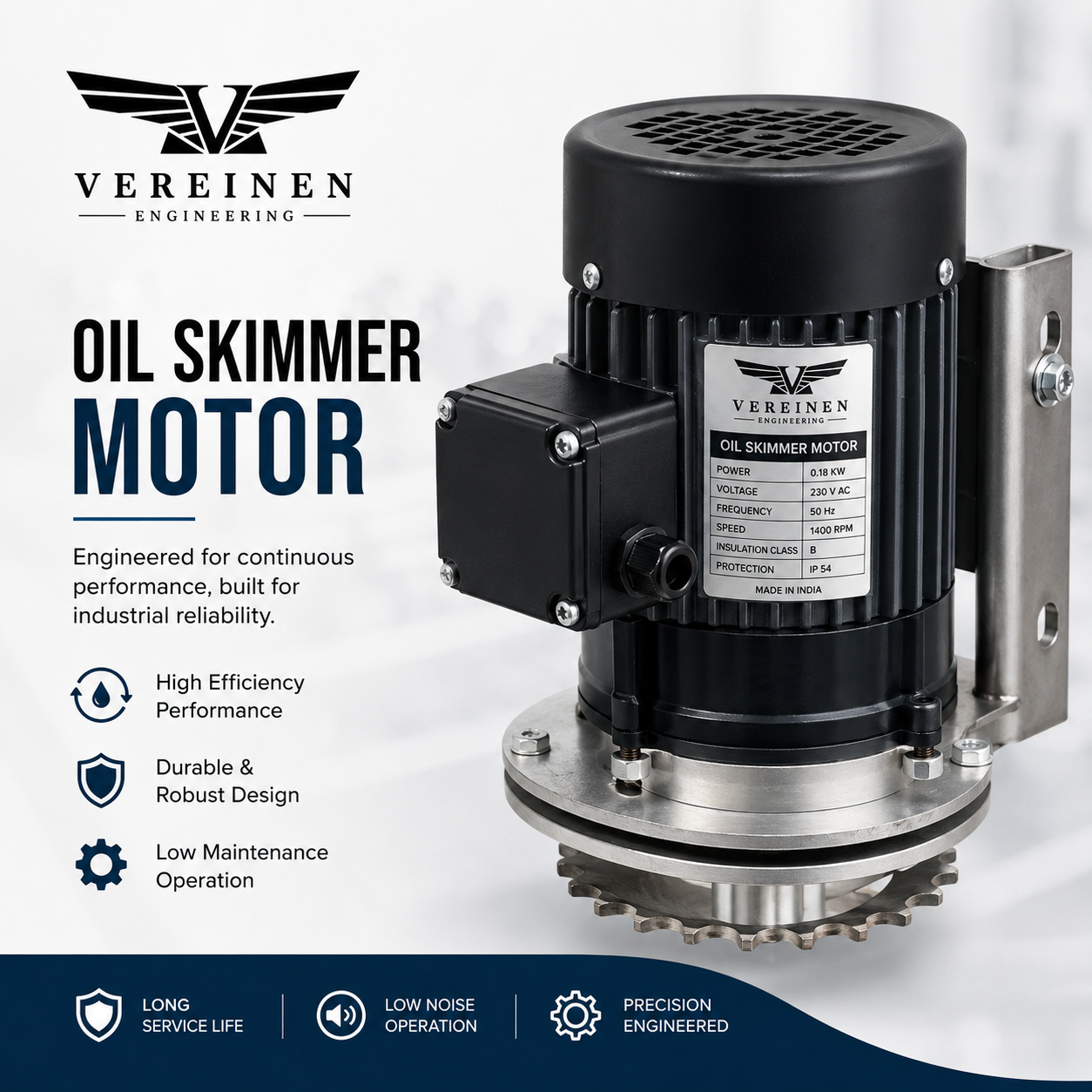 | Oil Skimmer Motor Vereinen Engineering is a Pune-based OEM manufacturer of premium-quality Oil Skimmer Motors, engineered to deliver reliable, energy-efficient, and... View product → |
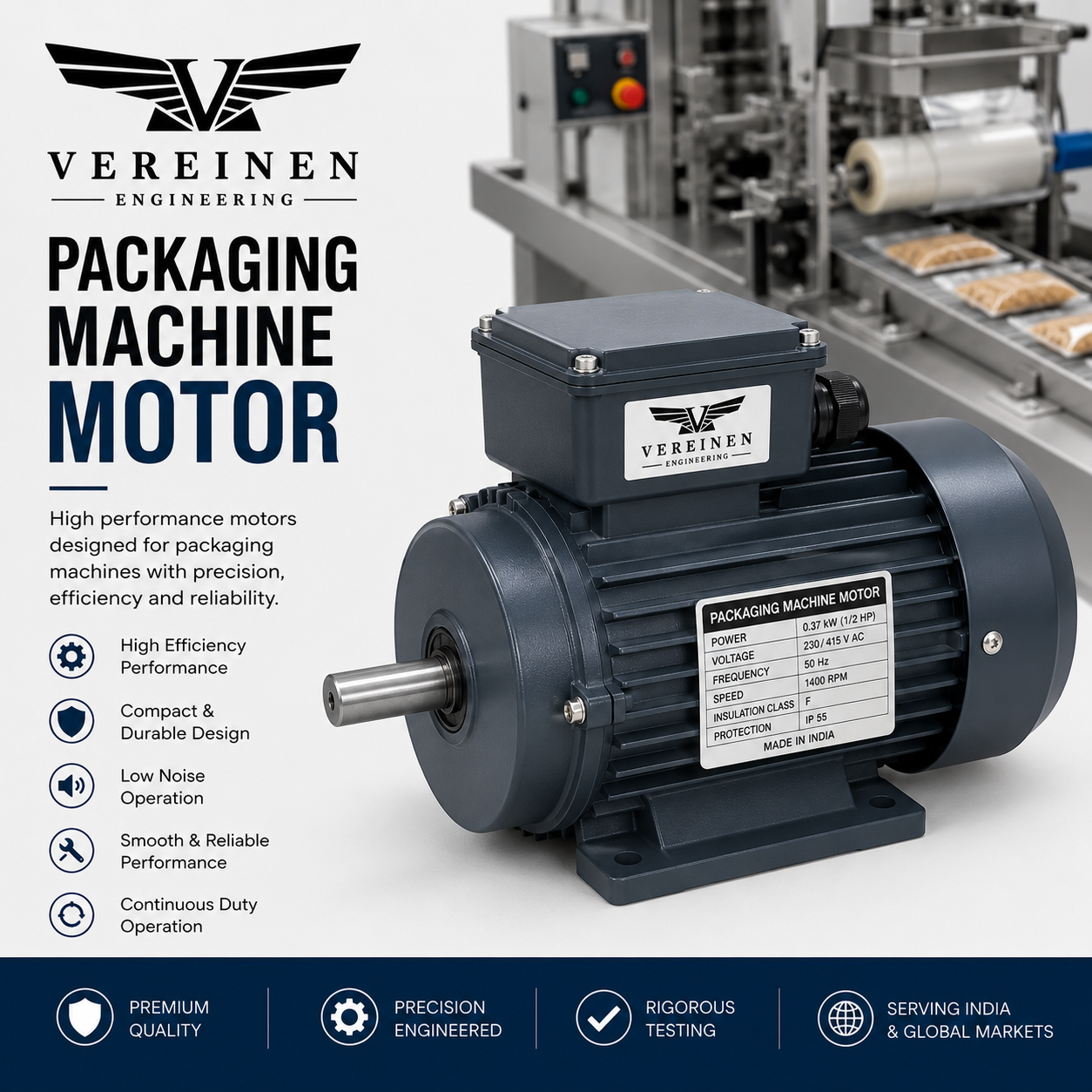 | Packaging Machine Motor Vereinen Engineering is a Pune-based OEM manufacturer of premium-quality Packaging Machine Motors, designed to deliver precise motion control, high... View product → |
Commission the drive under load and maintain the failure points
A drive fits the line only after it proves its performance under the collector’s actual load, including cold oil and worst-case sludge buildup. Treat oil skimmer motor options as unapproved until the acceptance record captures speed, current, torque, temperature and failure response.
1. Verify rotation, then measure no-load and loaded current. Confirm output rpm at every commanded setting, including the lowest speed, and compare measured torque with the skimmer maker’s requirement.
2. Inspect belt tracking or disc contact, confirm collection flow, and listen for abnormal noise. Measure gearbox temperature and vibration; use IEC 60034-14 for rotating-machine vibration measurements and IEC 60034-2-1 for motor-loss and efficiency test methods when supplier data needs verification.
3. Run the collector continuously for a sustained period and recheck temperature. Record the result, not merely “passed,” because rising temperature exposes undersizing, excessive drag or reducer problems.
4. Set inspection intervals for oil and sludge buildup, belt tension, shaft alignment, bearing wear, seal condition, cable entries, guards and cleaning access. Include cleaning access in the acceptance check; inaccessible deposits become drag and starting load.
5. Test or document the stall response. A stalled belt or disc can overheat the motor, damage the reducer or stop the wash process, so define overload protection, trip settings and restart behaviour before handover.
Recheck performance after seasonal temperature changes or altered coolant chemistry. Ask an oil skimmer motor supplier for the inspection record and service limits. Choose the drive that meets the maker’s speed range, measured torque and environmental requirements with an accessible maintenance plan—not the lowest price or highest kW rating.
Frequently asked questions
When does a packaging line need an oil skimmer?
Use one when a coolant, wash or parts-cleaning tank develops a floating oil layer that needs removal. The motor drives a belt, disc, drum or tube through the layer and into a collection tray.
How do you size an oil skimmer gearbox?
Start with the required collector speed, then account for fouling and the highest starting load. These conditions determine the gearbox ratio and output torque your motor for skimming equipment needs.
Which motor protection suits an oil skimmer tank?
Match the enclosure and electrical protection to splash, humidity, washdown chemicals and the tank location. Select speed control when the collector must run at different rates as oil loading changes.
What should you compare when choosing an oil skimmer motor supplier?
Compare the complete retrofit: motor, gearbox, mounting, coupling, controls, guards, collection arrangement and commissioning support—not only the motor label.
Related product
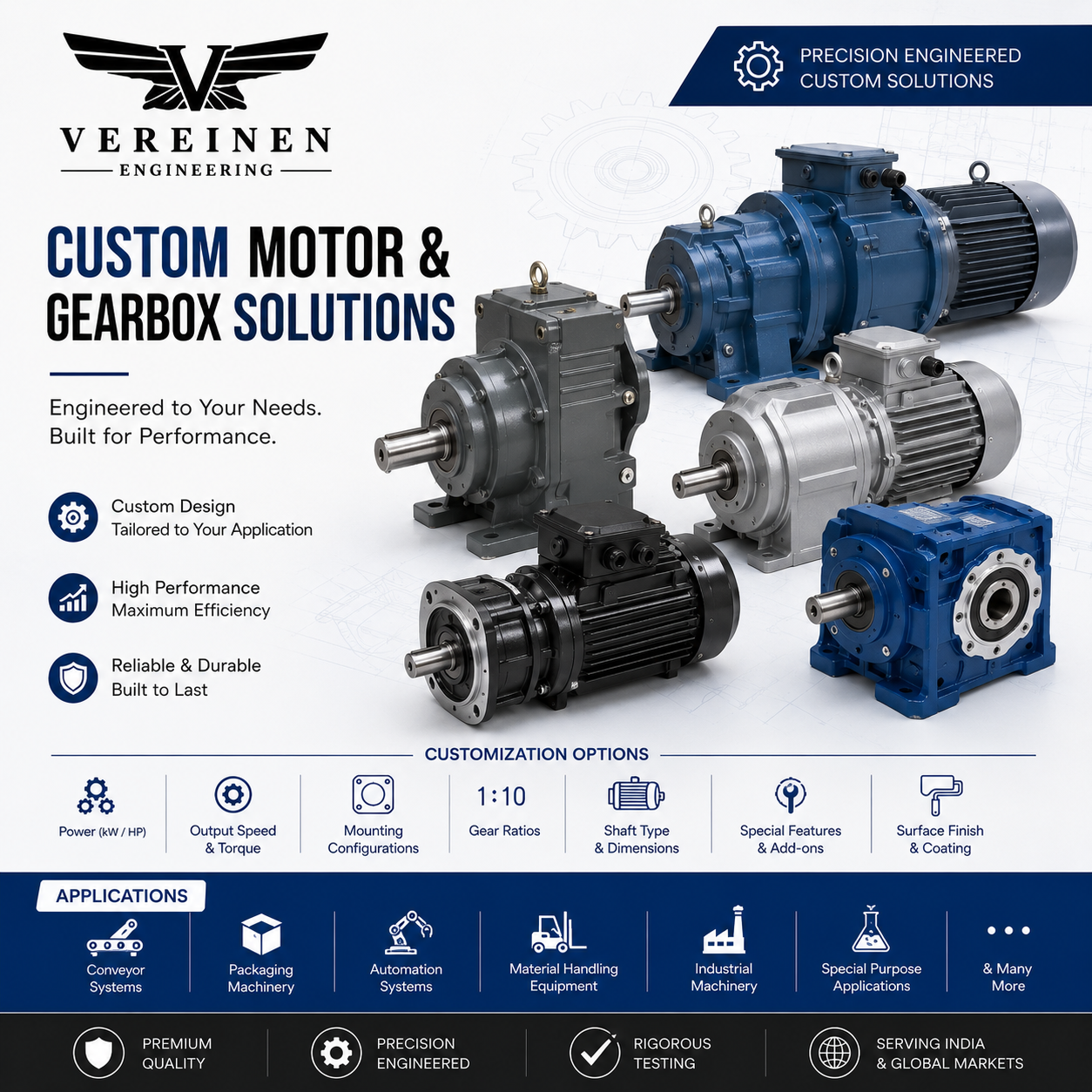 | Custom Motor & Gearbox Solutions Custom Motor & Gearbox Solutions Vereinen Engineering is a trusted Pune-based OEM manufacturer specializing in Custom Motor & Gearbox Solutions engineered to meet the unique... View product → |