
Pune monsoon conditions expose motors and gearboxes to more than direct rain: humid shutdown air can condense inside a warm motor, while splash, muddy dust, blocked breathers, and poor cable entries create hidden failure paths. By the end, you will know how to specify the enclosure, seals, tests, drainage, and installation checks that make a geared motor ready for wet service.
Key takeaways
- Survey spray, flooding, dust, pollutants, and washdown before selecting motor protection.
- Inspect cable glands, seals, drains, covers, and shafts as water-entry routes.
- Dry motors and control condensation before insulation testing or energising.
- Request a recorded wet-season test pack before dispatch.
Match the motor’s protection to the actual monsoon exposure
The right Pune monsoon motor protection depends on exposure, not the calendar. Start with an installation survey: record roof coverage, spray direction, standing water, muddy dust, industrial pollutants, pressure washing, and temporary-flooding risk.
| Option | Suitable baseline | What to verify |
|---|---|---|
| Sheltered plant | IP55 motor | Roof coverage prevents direct rain; choose corrosion protection for indoor humidity |
| Outdoor machine | IP65 or IP66 motor | Tie surface preparation and coating to the ISO 12944 atmospheric corrosivity category |
| Washdown zone | IP66 motor enclosure rating | Confirm seals, glands, and shaft protection withstand directed water and wet abrasive dust |
| Flood-prone location | No IP rating alone | Elevate the motor, provide drainage, or specify a separately designed submersible solution |
IP55 means protection against dust ingress and water jets; IP65 adds a dust-tight enclosure with water-jet protection. An IP66 motor enclosure rating provides a higher water-jet rating, but neither rating covers rust, condensation, or chemically contaminated rainwater.
A sheltered factory therefore needs a different coating and enclosure decision from equipment exposed to direct rain or pressure washing.
Specify the coating system and surface preparation against the site’s ISO 12944 corrosivity category, rather than accepting “monsoon-proof.” An IP-rated motor is not automatically suitable for submersion; floodwater requires a defined elevation, drainage path, or submersible design.
Inspect every route through which water can enter
A motor keeps its enclosure protection only when every water path is closed correctly; an incorrectly sized gland turns a sealed motor into an unsealed installation. Inspect before dispatch and repeat after mounting, following water from the cable entry to the bearing housing, not just across the frame.
Check these points:
- Inspect the terminal-box gasket for cuts, even compression, and distortion. Fit correctly rated blanking plugs to every unused entry.
- Verify cable gland sizing against the cable’s measured outer diameter. Confirm strain relief and the specified sealing washer or O-ring.
- Route cables downward or through a drip loop. Do not leave cable entries facing upward, where rain can pool around the glands.
- Complete the end-shield joint inspection, then examine the shaft seal, gearbox housing seam, breather, drain plug, and mounting interface.
| Exposure or detail | Inspection decision | Failure if overlooked |
|---|---|---|
| Direct spray or pressure washing | Ask whether the standard shaft seal needs a V-ring, labyrinth, or upgraded seal | Water and abrasive wet dust reach the bearing |
| Condensation drainage | Set drain holes and plugs in the orientation specified for the installed position | Water enters the terminal box or bearing housing |
| Harsh wet site | Specify corrosion-resistant fasteners and wet-service flexible conduit | Rust or cracked conduit creates another entry route |
Confirm drains release condensation without creating a direct rain path. A correctly sealed gearbox still needs its breather unobstructed; blocking it can force oil past seals or gaskets.
Control condensation before testing and energising
An externally dry motor can still contain motor condensation. After a hot motor stops, the winding space cools below the humid air’s dew point; water then forms on insulation and metal surfaces.
For a motor standing idle in Pune’s humid conditions, fit an anti-condensation heater with an interlock that powers it only while the motor is stopped. Disconnect the heater before energising the motor: a live heater can overheat the winding space.
A heater cannot remove water already inside, and it cannot correct a leaking cable gland or damaged gasket. Before commissioning, isolate the motor and complete a megohmmeter insulation-resistance test under recorded conditions:
- Test voltage, such as 500 V DC for many low-voltage windings; use the manufacturer’s stated voltage when it differs.
- Winding temperature, test duration, and weather or drying conditions.
- The measured value and the applied winding-temperature correction.
- The manufacturer’s minimum acceptance value and its reference temperature.
| Test result | What it indicates | Required action |
|---|---|---|
| Low after winding-temperature correction | Moisture or contamination remains possible | Use controlled drying and retest |
| Acceptable only before correction | Temperature has distorted the reading | Do not accept the uncorrected value |
| Meets the documented limit at reference temperature | Insulation satisfies the stated criterion | Proceed only after heater isolation and inspection |
Never energise a damp winding to “dry it out” without an approved procedure. Record the complete test pack, not a single megohm figure.
Require a recorded wet-season test pack before dispatch
Require a signed wet-season test pack as part of pre-dispatch motor testing, not a certificate that merely says “passes megger test.” The record must identify the motor and gearbox, test date, ambient and winding temperatures, insulation-resistance test voltage and duration, corrected insulation value, phase readings, earth-continuity result, and no-load current on each phase.
| Check | Factory record | Site repeat |
|---|---|---|
| Identification | Motor and gearbox serial numbers, test date | Confirm against nameplate and delivery documents |
| Insulation | Voltage, duration, winding temperature, corrected value, minimum limit, reference temperature | Repeat after transport, storage, and installation |
| Winding resistance | Reading for each phase and winding resistance comparison | Recheck an imbalance before energising |
| Earth continuity | Frame-to-earth result | Perform an earth continuity test to the site protective conductor |
| No-load current | Current on each phase against the expected baseline | Record current after installation and coupling |
Investigate phase imbalance before shipment; one winding-resistance number cannot reveal it. Inspect the gearbox housing seam, shaft seal, drain plug, breather, terminal-box gasket, cable glands, blanking plugs, and cable-entry hardware for leaks, cuts, distortion, or poor sealing.
At commissioning, photograph the terminal box, cable routing, covers, glands, plugs, drain orientation, and mounting position before closing the work order. These field details determine final ingress performance after the factory test.
VEREINEN ENGINEERING can make the evidence useful by tying a rain-readiness checklist to the supplied motor and gearbox rather than issuing a generic certificate.
Related products
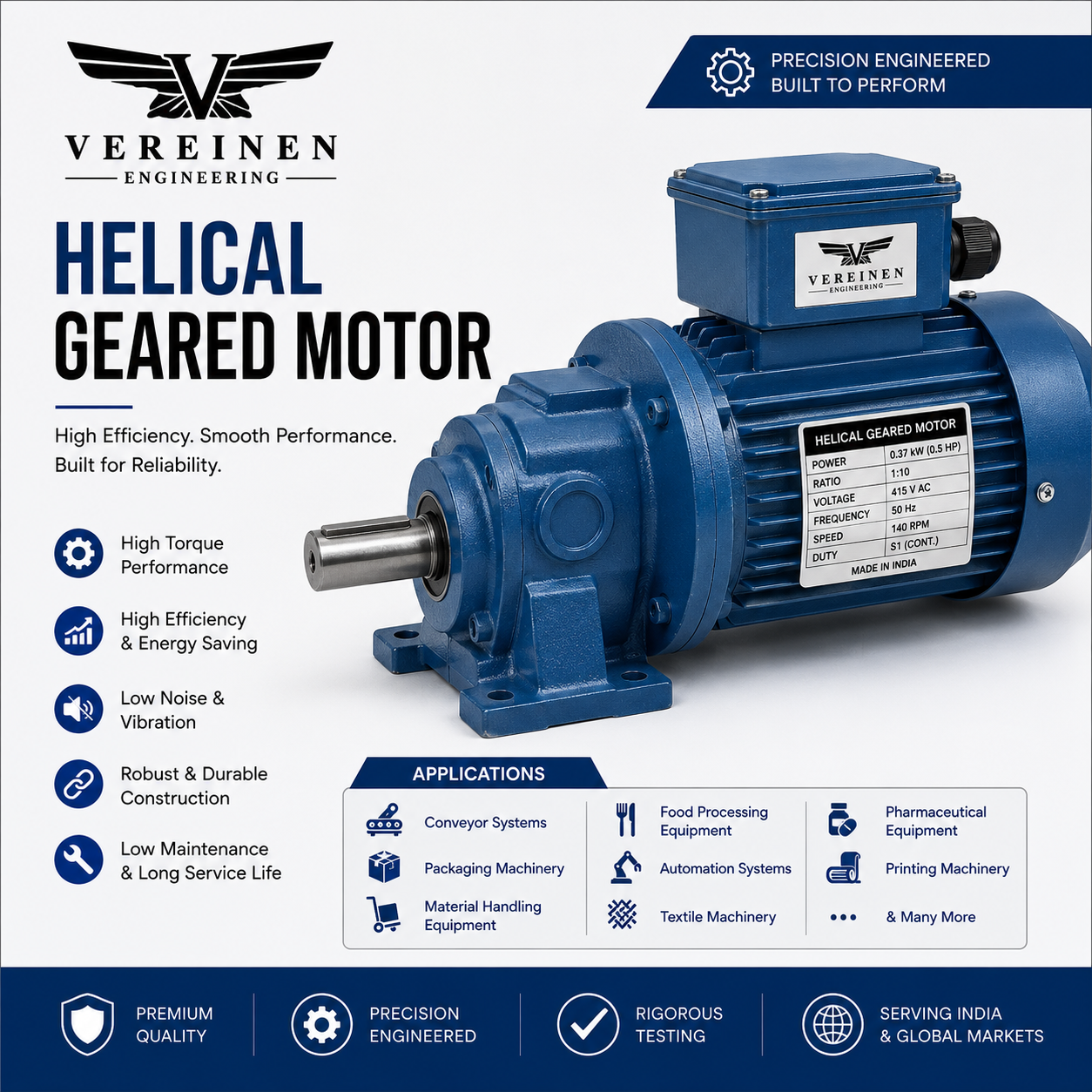 | Helical Geared Motor Vereinen Engineering is a trusted Pune-based OEM manufacturer of high-performance Helical Geared Motors, delivering reliable, energy-efficient, and... View product → |
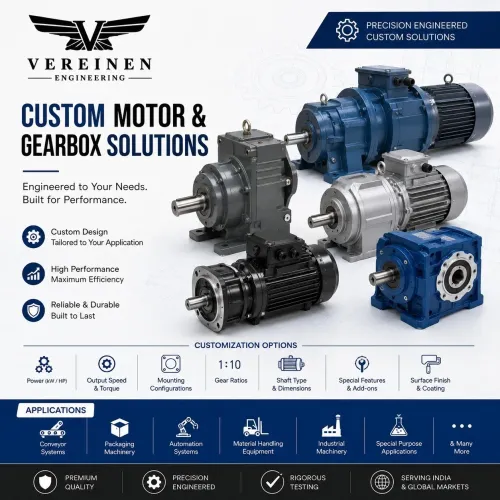
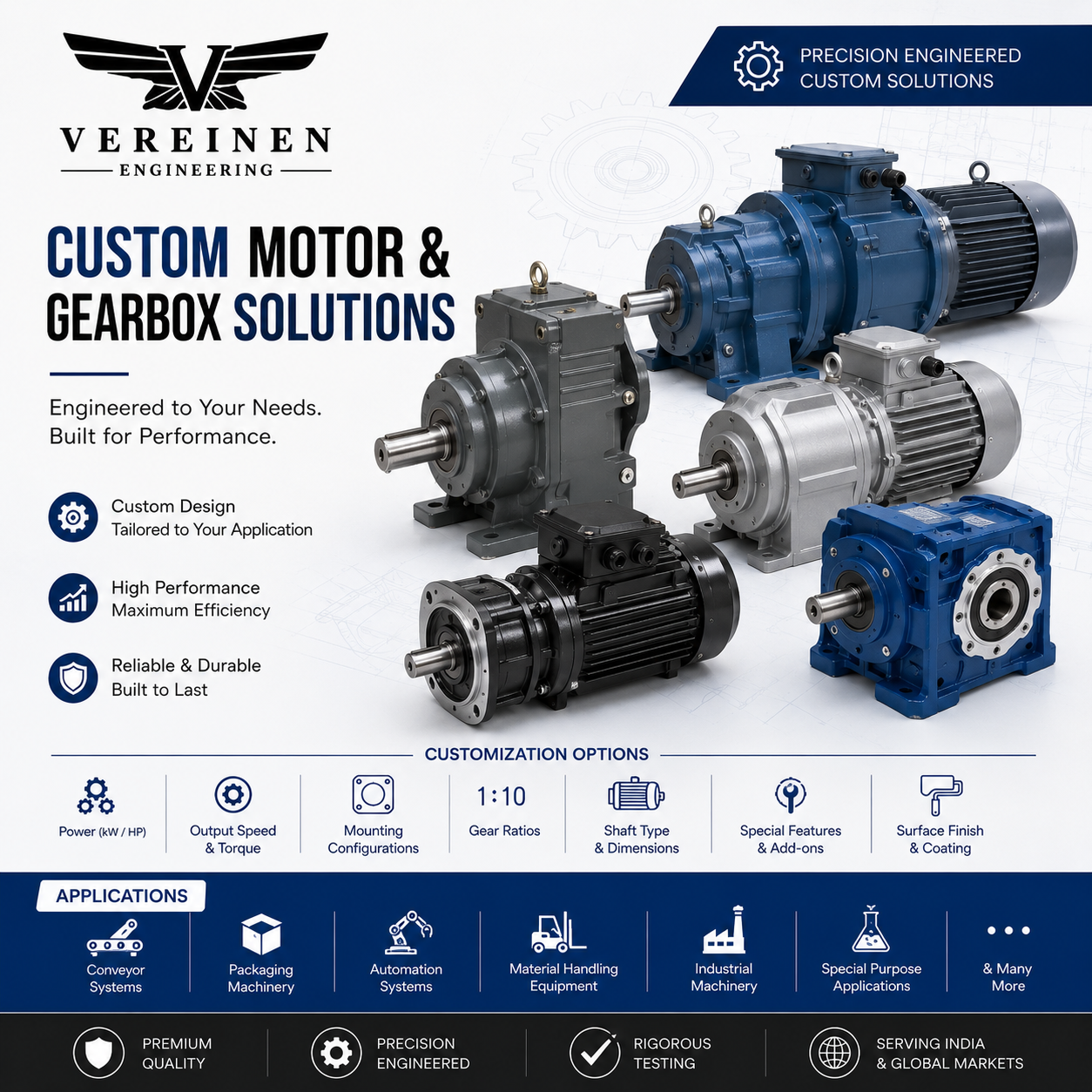 | Custom Motor & Gearbox Solutions Custom Motor & Gearbox Solutions Vereinen Engineering is a trusted Pune-based OEM manufacturer specializing in Custom Motor & Gearbox Solutions engineered to meet the unique... View product → |
Keep water out of the gearbox and the wider machine package
Once a motor drives a gearbox, conveyor, machine, or centrifugal blower, monsoon protection must cover the complete package, not the motor enclosure alone. Do not cap the gearbox breather: it equalises pressure as oil heats and cools, and blocking it can force oil past seals or gaskets.
Position and shield it according to the gearbox design, away from direct spray.
1. After heavy rain, inspect for gear oil water contamination: emulsification, abnormal cloudiness, a rising oil level, rust-coloured contamination, and water at the drain point. Water-contaminated oil can damage bearings and gears before the gearbox becomes noisy.
2. Examine the mounting interface for trapped mud, corrosion, loose fasteners, and misalignment. Check that drain holes and plugs remain correctly oriented so condensation can escape without opening a direct rain path into the terminal box or bearing housing.
3. Give centrifugal blower rain protection to the whole airflow path. Fit weather hoods, orient inlet and outlet openings to prevent rain entry, maintain drainage, and inspect the impeller for wet dust buildup that can create imbalance.
4. Complete a post-storm motor inspection: inspect glands and plugs, confirm drains are open, check for standing water, examine seals, and record every oil or insulation change. Add findings to the commissioning and maintenance record instead of treating rain readiness as a one-time factory claim.
Frequently asked questions
How do you match motor protection to Pune monsoon exposure?
Survey roof coverage, spray direction, standing water, muddy dust, industrial pollutants, pressure washing, and temporary-flooding risk before selecting protection.
Which routes let water enter a geared motor?
Inspect cable glands, terminal-box covers, shaft seals, drain plugs, mounting interfaces, breather arrangements, and damaged paint or gaskets.
How do you control condensation before testing a motor?
Dry the motor, remove surface moisture, check insulation resistance, and resolve condensation before testing or energising it.
What should a wet-season test pack contain before dispatch?
Require recorded inspection results, insulation-resistance readings, seal and gland checks, functional-test results, and photographs of the completed motor.
How do you keep water out of the gearbox and machine package?
Protect breathers and cable entries, position drains correctly, prevent pooling, seal machine interfaces, and verify that surrounding guards do not direct water toward the gearbox.
Related product
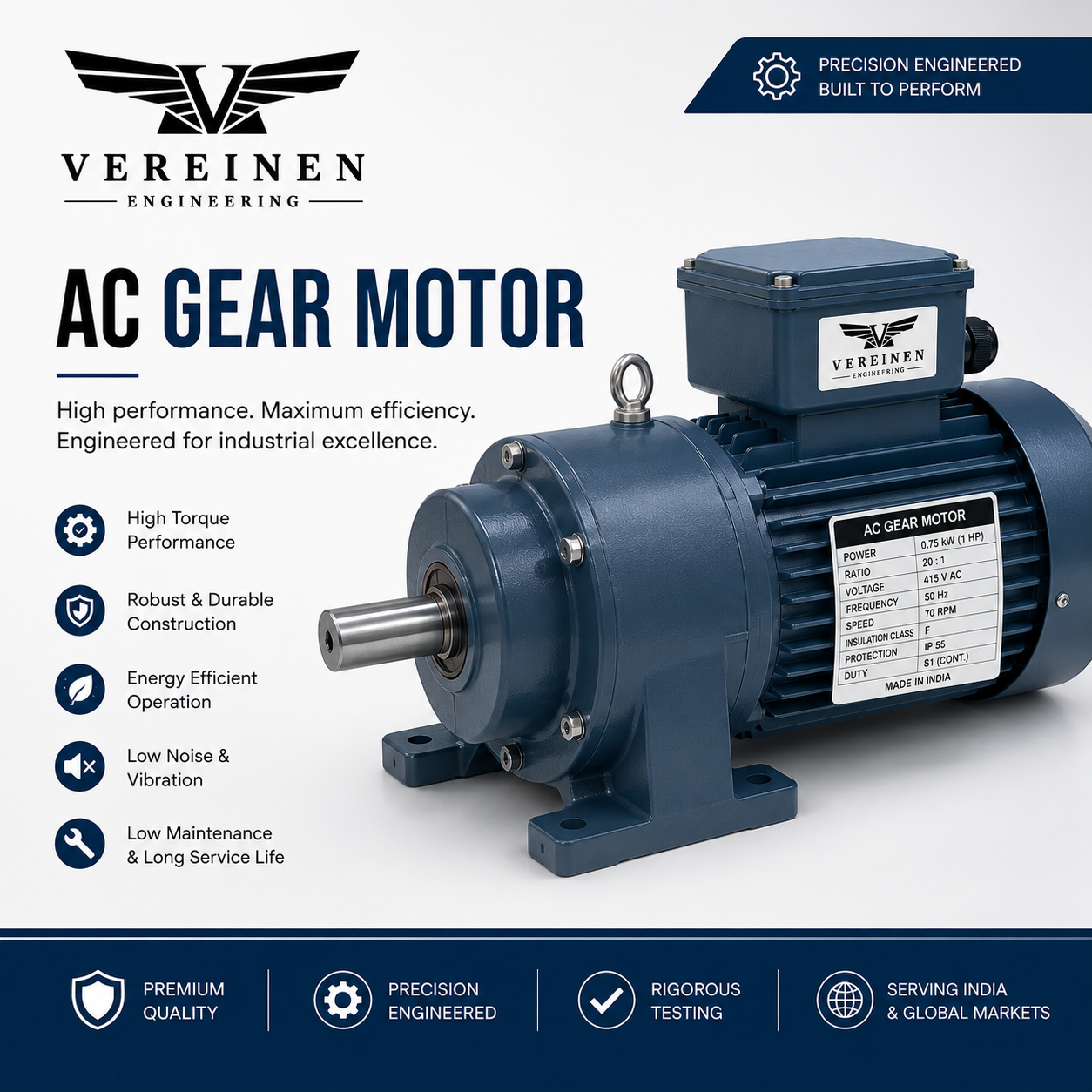 | AC Gear Motor Vereinen Engineering is a Pune-based OEM manufacturer of premium-quality AC Gear Motors, engineered to deliver efficient power transmission, high... View product → |