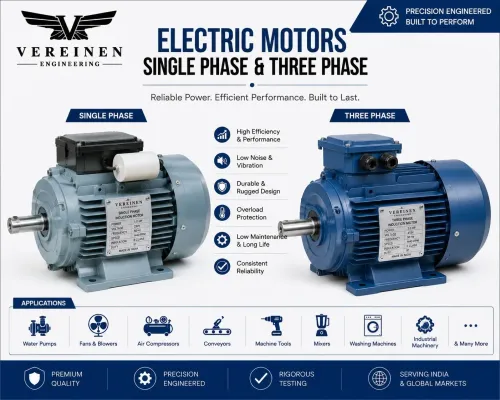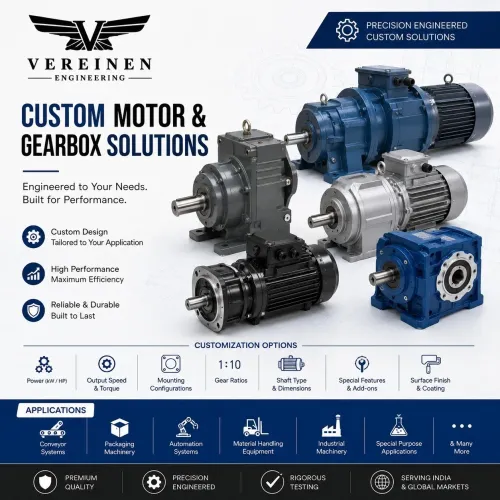

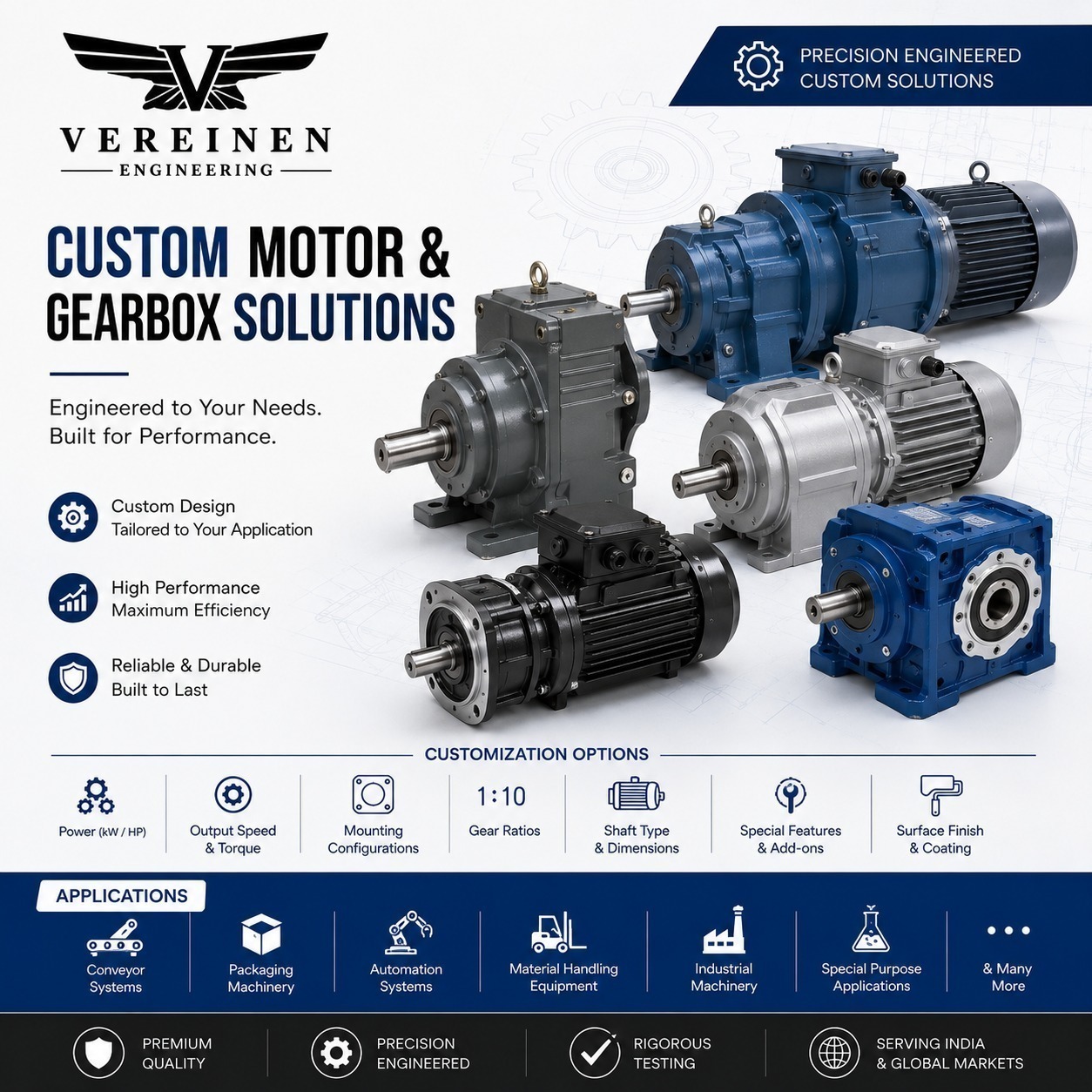
Standard motors are practical when machine requirements align with established electrical and mechanical configurations. However, equipment designers sometimes encounter situations where the motor has appropriate power but does not fit physically, provides the wrong speed, uses an unsuitable shaft, or cannot integrate with the intended gearbox. In such cases, customisation may be more practical than redesigning the entire machine.
A Custom Motor Manufacturer in Pune becomes relevant when the motor needs to be adapted around a defined equipment architecture. Customisation does not necessarily mean designing every component from the beginning. It may involve changing selected characteristics to achieve better integration.
Common custom requirements include:
Special shaft length or diameter
Modified mounting arrangement
Application-specific flange
Different operating RPM
Particular voltage requirements
Gearbox integration
Direction-of-rotation requirements
Dimensional restrictions
Special connection arrangements
The first sign that customisation may be justified is repeated compromise. If engineers are adding unnecessary brackets, couplings, adapters, or transmission components simply to accommodate a standard motor, reviewing the motor specification itself may produce a cleaner solution.
Production volume is another consideration. For a one-off prototype, modifying the surrounding machine may sometimes be practical. For OEM equipment manufactured repeatedly, a properly defined custom motor can help standardise assembly and reduce recurring installation complexity.
Pune is home to numerous automation businesses, machine manufacturers, equipment developers, and engineering companies supplying machinery across Maharashtra and India. Many build special-purpose equipment where dimensional constraints and operating characteristics are established by the machine rather than by a standard motor catalogue.
VEREINEN ENGINEERING works with custom motor requirements in Pune, including application-specific electrical and mechanical configurations. A productive customisation discussion should begin with technical information rather than a general request for a "special motor."
Buyers should prepare the existing motor drawing where available, required power, input supply, target speed, torque expectations, shaft dimensions, mounting arrangement, gearbox details, duty cycle, operating environment, and expected production quantity.
Customisation is most valuable when it solves a genuine integration or performance requirement. The objective should not be to make a motor different for its own sake. It should be to create a drive configuration that fits the machine more naturally, reduces unnecessary mechanical adaptations, and can be reproduced consistently for future equipment.